
Living in the Forest Without Losing It
A practical arborist’s guide to defensible space, tree health, and long-term property stewardship in the Truckee and Lake Tahoe region.
Defensible space in Truckee is one of the most common topics I cover with homeowners and the question almost always sounds like this: “How do I protect my house without destroying the forest I moved here to live in?” It’s a fair question, and it deserves a straight answer.
The honest answer is that protecting your home and maintaining the character of your property are not competing goals. Done right, defensible space work doesn’t strip a property bare. It restores the forest to something closer to its natural, fire-adapted structure. But getting there requires understanding what actually puts your home at risk, what a healthy Sierra Nevada forest is supposed to look like, and what mistakes to avoid along the way.
The ScienceWhy Zone 0 Matters More Than the Tree 80 Feet Away
Research has fundamentally changed how fire scientists understand home ignition. The biggest threat to your house during a wildfire is not the forest behind it. It’s what’s within five feet of your foundation.
USDA Forest Service fire scientist Jack Cohen spent years studying how homes actually ignite. His Structure Ignition Assessment Model found that burning vegetation flames are rarely the direct cause of home ignition. The real culprit is embers: wind-driven embers that can travel more than two miles and land on any combustible surface they find. Research from the Insurance Institute for Business and Home Safety (IBHS) confirms that the 0–5 foot zone around your home has a greater impact on survival than any other area of your property. A UC Berkeley study found that home hardening combined with proper defensible space can cut wildfire damage in half.
“Clearing brush 100 feet out is still important, but we’re seeing more losses start within just a few feet of the home. That first five feet can make the difference between a home surviving or being lost.”
— Holly Sacks, Mercury Insurance wildfire expertWhat this means in practice is that the pine needles in your gutters, the wood mulch against your foundation, the gaps in your deck boards, and the unscreened vents on your eaves are often more dangerous than the 80-foot Jeffrey pine standing 40 feet away. Fix those first. Then work outward.

Zone 0 done right. Gravel perimeter, no combustibles against the foundation, clear gap between plants and siding. This is the single highest-impact change a homeowner can make. Photo: Alpen Tree Experts.
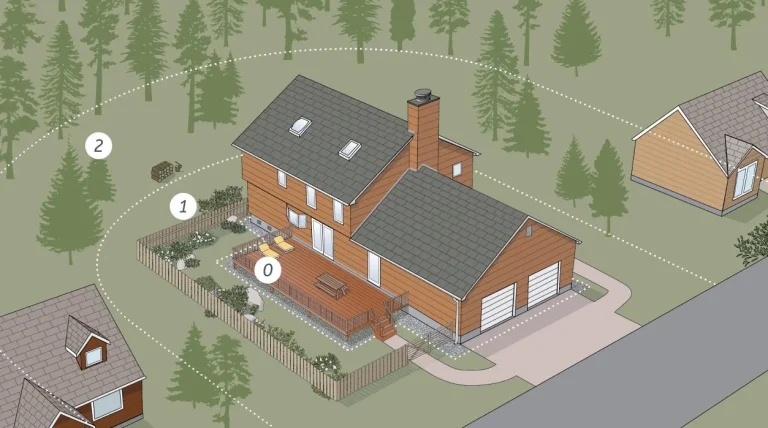
Defensible Space Zones: What Each One Actually Requires
- No combustible bark or mulch around the structure
- Remove all dead and dying weeds, grass, plants, shrubs, trees, branches, and vegetative debris (leaves, needles, cones, bark, etc.
- Remove dead or dry leaves and pine needles from roof and gutters
- Remove all branches within 10 feet of any chimney, stovepipe, or roof
- Remove or prune flammable plants and shrubs near windows
- Limit combustible items (outdoor furniture, planters, etc.) on decks
- Relocate firewood and lumber to Zone 2
- Consider relocating garbage and recycling containers, boats, RVs, vehicles, and other combustibles outside this zone
- Remove dead plants, grass, weeds, and vegetative debris
- Trim tree branches to a minimum of 6 feet from the ground
- Cut or mow annual grass down to a maximum height of 4 inches
- Create separation between trees, shrubs, and items that could catch fire, such as patio furniture, wood piles, swing sets, etc.
- Cut or mow annual grass down to a maximum height of 4 inches
- Create spacing between shrubs and trees, as continuous canopy and shrub layers spread fire
- Reduce duff (fallen leaves, needles, twigs, bark, cones, and small branches) to a maximum depth of 3 inches
- All exposed wood piles must have a minimum of 10 feet of clearance, down to bare mineral soil, in all directions
This Isn’t Sacrifice: It’s Restoration
The overcrowded, impenetrable forest that many Tahoe properties have today is not what a healthy Sierra Nevada forest looks like. It’s what the forest became after more than a century of fire suppression.
Before European settlement, Sierra Nevada mixed-conifer forests burned in low-to-moderate intensity cycles roughly every 6 to 12 years, maintained by both lightning ignitions and intentional burning by Indigenous communities. The result was what historical accounts describe as park-like woodlands: widely spaced mature trees, sunlight reaching the ground, an understory you could walk through and see across. Not stripped bare, just open and structured.
A century of fire suppression and poor forest management reversed all of that. Tree density increased dramatically. Shade-tolerant white fir crowded out Jeffrey pine. Without fire moving through periodically to clear the understory, fuel loads stacked up and the natural spacing that kept individual trees healthy disappeared. The bark beetle epidemics that have killed thousands of trees across the basin are a direct consequence: stressed, overcrowded trees can’t produce enough pitch to fight off beetle attacks. A properly spaced, well-structured stand is more resistant to both fire and beetles.
When we thin a stand, limb up the ladder fuels, and remove crowded understory around a home, we’re not damaging the forest. We’re giving it back its fire-adapted structure. The large trees with a favorable growth form that remain will be healthier, more wind and snow load tolerant, and more resistant to bark beetles because they’re no longer competing with 40 neighbors for the same water and sunlight.
What you end up with isn’t a parking lot. It’s closer to what John Muir actually walked through.
The Most Common Mistakes I See
Removing all pine needles and duff outside of Zone 0
A 1–2 inch layer of needle duff beyond the immediate structure zone is not a fire hazard. It’s a resource. Bare soil dries out faster, heats up more, and depletes the moisture your trees depend on. The result is a dusty, degraded yard and stressed trees that are more vulnerable to bark beetles. Manage Zone 0 aggressively. Leave a 1–3 inch duff layer everywhere else.
Poor pruning technique
Two failure modes: cutting too close to the branch collar, which destroys the tree’s natural defense zone and opens a pathway for decay; or leaving long stubs, which die back, rot inward, and create structural weakness over time. Every cut either helps or hurts the tree. There is no neutral. Hire someone who knows where to make them.
One-time clearing without ongoing maintenance
Defensible space is not a project. It’s a practice. Annual or biennial walk-throughs should target the same recurring issues: shrub regrowth before it matures and accumulates deadwood underneath, excess pine needle buildup especially in Zone 0, and dead woody debris on the ground. It’s the older established shrub growth that poses the greatest fire risk. Years of deadwood and debris accumulation underneath make mature shrubs far more flammable than young regrowth. Trees near structures should also be checked every few years to confirm that branches have maintained adequate clearance from the building as the trees continues to grow.
Hiring unlicensed contractors
This is a significant and ongoing problem in the Truckee area. Unlicensed crews are often uninsured or not properly insured. If there’s an injury, property damage, or a tree failure on your property, you as the homeowner may be fully exposed. They frequently don’t stand behind their work: if your property fails a reinspection, they’re gone and the cost of remediation falls on you.
If cost is a concern, the right approach is to get multiple bids from licensed, insured contractors. Pricing varies meaningfully among legitimate professionals, and competitive bids from qualified contractors will get you the best value without putting your property or your liability at risk.
Before hiring any contractor, verify their license number with the California State License Board. It takes less than a minute and can save you significant trouble: Check a Contractor License (CSLB).
Want Professional Eyes on Your Property?
Alpen Tree Experts has been serving the Truckee and Lake Tahoe region for over 20 years. ISA Certified Arborist #WE-9055A | CSLB #959783
Get in Touch